Projects

Yi's Eatery

Project Lead, Game Designer, Programmer
Restaurant Simulation
Group of 4
5 months in Unity
Developed for VR and Mobile
Overview
Yi's Eatery is a chaotic couch co-op cookstravaganza that puts players in charge of crying, cooking and customer service.
Set in Singapore during the 1980s, the Yi family are continuing the dynasty of their recently-deceased grandmother, who ran a chicken rice stall for generations.
Aimed at groups of people who like playing casual party games or families that want to bond over games, this can be played using a VR headset and up to 4 Android mobile devices.
The VR player takes on the role of a chef and cooks in the kitchen, while the mobile players play as the servers, running around the entire shop and takes care of customer service.
Game Design
Player Characters
Chef
Xiao Beng is a rebellious delinquent. However, there is no one he loves more than his dear Grandmother, Ah Ma. Ah Ma was getting on her years and didn’t have much longer to live. On her deathbed, Ah Ma revealed that her last and final wish was for her family to carry on the proud tradition of running Ah Ma’s Food.
The loss of Ah Ma devastates Xiao Beng, and he decides to listen to his grandmother, convinced that this was the only thing he could do for her as her beloved grandson.
Xiao Beng turns over a new leaf. No, he was no longer Xiao Beng… he was now Xiao Ben.
Alongside his family, Xiao Ben takes over Yi's Eatery, and works diligently, determined to turn the shop into a booming business, and every Singaporean’s favourite eatery.
Servers
The servers are the chef’s - Xiao Ben - family members.
They consist of the bratty sister Xiao Li, the always-hungry Xiao Fan, together with the stoic Asian father Da Fan, and the aunty mother Da Li.
Together, the Yi family will carry on Ah Ma’s legacy and bring the business to greater heights.
Objective
The chefs and servers must work together to achieve the following:
-
Ensure customers are served their desired food item
-
Do not take too long to serve customers
Individually, the chefs and servers have several key objectives.
Chef
-
Prepare the ingredients to assemble the food item
-
Meet the needs of orders from customers
Server
-
Supply ingredients to the chef.
-
Wash the dishes to supply clean plates for the chef to serve food
-
Serve food from the chef to the customers
Shop Design
Since Yi's Eatery is set in Singapore in the 1980s, we took inspiration from the layout of small family-owned shops during that period.
One of the few things we noticed about such shops was the "open-door" culture. The kitchens weren't segregated from the rest of the shop by any doors or walls, instead they were integrated into shops so the cook could get a full view of what is happening in the shop.
There were also no designated doors at the entrance of the shops. Shutters were used instead and when the shops were open, the shutters would be pushed up completely, allowing customers to stream into the shop from all directions.
To stay true to such a culture, the level map I came up with features a very open area, where different sections of the shop come together seamlessly, without unnecessary doors.
This also makes it effective for gameplay, as customers can come in waves easier, without having to squeeze through a small opening. The servers can also see all the customers coming in and make preparations to accommodate them.
Here is what the full level map looks like:

-
The kitchen has been integrated to fit the shop, fitting snugly in the top left corner.
-
No physical doors or walls separating the kitchen from the rest of the shop
-
Chef can see whatever is going on in the shop while still only staying in the kitchen
-
-
Much like the old shops, tables are of varying sizes
-
Accommodates for small groups of customers or families of 4
-
Table of 6 could possibly be introduced into the game to allow for more customers
-
-
Players are given sufficient space to run about the shop
-
Large space lessens chance of players bumping into one another
-
However, there can definitely be more tables, since having tight spaces to some extent does facilitate chaos
-
-
Customers who want to dine-in will enter from the entrance via the walkway
-
Customers who want to takeaway food will line up along the counter and wait for their order
Actions that can be taken by servers:
-
Welcome customers at entry way and direct them to a vacant table
-
Take orders of customers and deliver it to the chef
-
Take prepared food from the chef and serve it to customers
-
Clean tables so it is vacant and ready for the next customer
-
Handle takeaway orders from customers at the cashier
Kitchen Design
Since the chef will be staying inside the kitchen for the whole game, the design and placement of props and utensils in the kitchen is of utmost importance.
Again, the kitchen layout is very much inspired by olden-day shops and hawkers.


-
Pots at the back of the kitchen, chef can boil the chicken whole
-
Ingredient tray for servers to pass ingredients to the chef
-
Kitchen does not contain any ingredients and chef must rely on servers
-
Ensure there is always a steady supply of ingredients
-
-
Dish counter is where the finished dish will be placed, servers can then collect it and serve to the customers
-
There is a glass panel where the hanging chickens are displayed
-
The chef can also place ingredients in a small shelf under the display glass panel, making space on the ingredient tray
Actions that can be taken by the chef:
-
Receive ingredients from servers and place them on shelves
-
Refer to recipe book for dishes
-
Chop ingredients
-
Pour water into pots and woks and boil ingredients
-
Serve completed dishes to servers via the counter
Storeroom Design
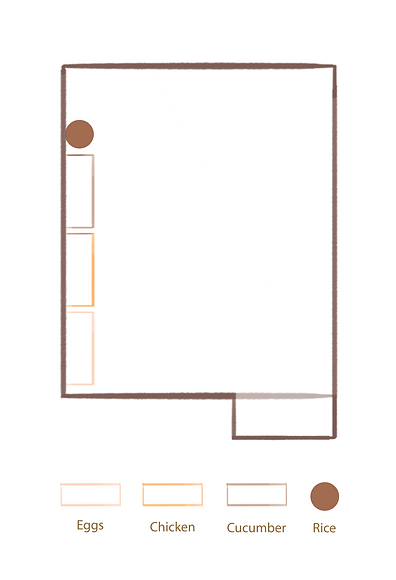
The last room is the storeroom, where the servers go to get fresh ingredients for the chef.
It can be accessed through an opening at the back of the shop.
-
3 different shelves containing the ingredients and a tub of rice on the floor
-
Mostly empty apart from some additional props like barrels or crates
-
Players are not encouraged to spend much time here
-
-
Servers only have to go to the storeroom for ingredients and will spend most of their time in the shop
-
Design of the storeroom is blander than the shop so servers won't have a reason to stay in the room for too long
Actions that can be taken by the servers:
-
Take a set amount of ingredients from the different tubs on the shelves
-
3 different shelves
-
Eggs
-
Chicken
-
Cucumber
-
Conclusion
It was the first time I worked on a project of such scale, and also the first time I handled networking. Having to design a level in the form of a shop was quite challenging too, and I had to analyse levels from games like Overcooked 2 and Diner Dash to try and get a better idea of how props and items should be placed.
However, this project was the culmination of all I had learned in Ngee Ann Polytechnic, and a fitting conclusion to my journey there. There were many skills learnt through this project, and I found a new appreciation for studio-based projects and the importance of communicating well with my team.
While I was also in charge of programming and networking mobile mechanics, working on Yi's Eatery's design made me realise that my passion lies in game design.
Overall, I am very satisfied with the progress we made on this project despite the time constraints, unfamiliarity of using a new platform and having to learn networking on the fly.
You can see the fruits of months of hard work in the trailer below!