Projects

Overcooked Game Analysis

Overview
Overcooked is a local multiplayer cooking simulation game released in August 2016, and has a rating of 78% on Metacritic and 8.4/10 on IGN.
If you are not familiar with Overcooked, Epic Games sums it up pretty well:
“Overcooked is a chaotic couch co-op cooking game for one to four players. Working as a team, you and your fellow chefs must prepare, cook and serve up a variety of tasty orders before the baying customers storm out in a huff .” – Epic Games
While Overcooked 2 has also been released, some players still feel Overcooked is more challenging and has less gimmicks, which is why I chose to analyse Overcooked instead of Overcooked 2.
After all, Overcooked is the predecessor of Overcooked 2, and there has to be a reason it garnered such a huge following and fanbase.
Game Design
The controls of Overcooked are fairly simple and easy to grasp, even for beginners.

While players can choose to play the game alone, it is much more enjoyable and manageable as a co-op game.
Note: Players can also dash to move faster. However, this was not included in the controls screen and many players were unaware of the ability.
Apart from running, there are 5 basic actions players can perform:
-
Grabbing
-
Chopping
-
Cooking (Grilling/Baking/Boiling)
-
Serving
-
Washing dirty plates

Actions can be categorized into 3 main sections:
-
Press the button once
This includes grabbing ingredients, plates and dishes, as well as serving up the dishes.
-
Press and hold the button until a gauge fills
This includes chopping and washing dirty plates.
-
Press the button once and wait for the gauge to fill
This includes all forms of cooking, with set amounts of time to wait for the food to finish cooking.
Overcooked is largely a co-op game, handling up to 4 players at once. It is worth mentioning that while there is a solo mode, the player will still have to control two different characters using two different sets of controls.
There’s no AI to help out so playing in single-player is something players tend not to like and is likely not the reason they bought the game for.
Right from the get-go, players are encouraged to co-operate in order to complete orders more efficiently.
Tutorial
Looking at the tutorial level, players are already taught how to pass ingredients to each other using tables split down the middle of the map.

This is seen in the first level as well, where players are introduced to washing dirty plates, and their first recipe, the soup.
Sporting a similar middle table, it is immediately apparent that players will save so much time passing ingredients back and forth as opposed to running all around the tables and trying to get things done alone.
Let’s also take this chance to familiarize ourselves with the tables and different equipment, they are labelled below.

Uses levels to teach players
Taking a deeper look into the level design of Overcooked maps, one of the things that struck me was how Overcooked makes use of its map designs to teach players the basics of certain mechanics or design decisions.
The overworld of Overcooked has different areas with different themes. Each area also introduces a new recipe and map design to the players.


In stage 3, the map is set in the arctic area, which is why in 3-1, players are introduced to the ice terrain.
It’s a straightforward map with all the tables tightly packed, players have to run in a circle around the tables.
This level features:
-
Slippery ice, players feel like they are sliding around
-
No walls to block players from falling
-
Dashing is dangerous and can cause players to fall into the waters
-
Players take 5 seconds to respawn
-
-
Ice can be used to drift and move quicker once players get adept at it
This map introduces players to the slippery ice and readies the player for level 3-4:

In Stage 3-4, the slippery ice makes a return, this time bringing about a new obstacle – the moving ice blocks.
-
Players have to dash across the ice block at the right time to reach the other platform
-
There are holes that are overlooked, causing players to fall into the icy water in an attempt to reach the ice block or the other platform
Looking at a different example, stage 4-1 is perfect in setting up players’ expectations for later stages.
Set in a haunted forest, stage 4-1 features a haunted restaurant, with moving tables and also a new recipe, pizza!

This stage changes up the formation of the tables while still providing routes for the players to move in.
-
Players have to change their roles according to the table formations
-
Middle tables also contain equipment ie. Chopping board, so players on both sides can use it
-
Open routes, even if players get ‘locked in’ by the tables, they can take a longer route to get to the other side
-
Change in table formation isn’t very disorienting, it just moves from left to right and vice versa
The table formation isn’t so punishing in this level, and players don’t get blocked in. However, this is not the case in stage 4-3, where the table formations are more complex and block players out from certain areas.

It starts off with a straightforward layout, 4 corners are separated by tables, but with an opening in the center of each alignment to allow for players to move around freely.
-
Tables start to move, players are blocked off from each other and can only traverse certain routes
-
Requires co-op play since only one player has access to some ingredients, and the other player has access to serving station
-
2 different table formations that section players off differently. However, there is always at least one ingredient both players can access from the same tables.
-
No set route for players to take to get to tables, diagram only depicts the straightforward routes, but players can run however they want and still reach the tables
-
Giving players a large area to run about also gives a false sense of freedom, even though they are boxed into their respective areas
Co-op enhances efficiency
It is no coincidence that Overcooked is a co-op game, as its level designs encourage players to co-operate.
One mechanic implemented that leverages player co-operation for a more efficient gameplay is the pesky rats that steal food.
Rats
-
Rare mechanic, only used in one or two stages
-
Rats come out of tables and steal whatever ingredients are lying around
-
Players can shoo rats away by pressing a button when near the rat, but the hitbox is pretty small
-
Players can circumvent this by picking up the ingredient when the rat is here and it will run away
-
Rats do not spawn if there are no ingredients lying around

-
Players can co-operate to maximize efficiency and reduce chance of rats spawning
-
Players can pass ingredients across the tables
-
Players can cut the ingredients quickly and pass it to be placed into the soup as quickly as possible
Room Switching
In stage 5-1, players can press the button to switch where the room at the bottom of the screen will go.
The room contains ingredients and the sink, and while players can technically cook and serve mostly by themselves, they are encouraged to rely on each other.

-
Players have their own area, with symmetrical layout, and can get ingredients from one room
-
Have to send the room back and forth so both players can get the ingredients
-
Service stations at both sides, players don’t have to rely much on each other, but since the sink is also in the room, players have to toggle the button to take turns washing plates at some point.
-
Doing it co-op and switching back and forth makes it much easier as well
Conveyor Belts
Conveyor belts are also very often used in Overcooked maps, where ingredients placed on it are usually headed straight for the trash.
These levels usually require players to have to rush to grab ingredients off the conveyor belt before they disappear into the trash bin.
Level 2-4 is a great example of how conveyor belts are being used.

-
Conveyor belts going towards the trash
-
Cooking and chopping stations separated
-
Tables block players from reaching all parts of conveyor belt, have to get there quickly to pick up the ingredient
-
Players optimize and choose the speed by choosing where to drop the ingredient on the conveyor belt
-
ie. Closer or farther
-
Stage 4-4 uses both moving tables and conveyor belts and makes a level that cannot be played if players do not co-operate.

-
Moving tables that push players up or down
-
Players are stuck with the same roles and get used to it
-
Players have to pick up dirty plates and place them on their tables beforehand
-
Players have to use conveyor belt to transfer ingredients
-
Players take turns serving dishes
Stage 6-2 has conveyor belts that separate players.
One of the special stages that differ for four players, since it would be far too easy for 4 players to pass ingredients back and forth with very minimal use of the conveyor belts.

-
Conveyor belts split players apart
-
Ingredients in different places
-
Chopping and cooking are separated, different players are in charge
-
Players have to pass ingredients to one another using the conveyor belts
-
Players usually only have to pay attention to two belts: One to receive ingredients from, and the other one to pass ingredients through.
-
Areas are direct opposites of each other
Table Placements
In Stage 5-5, players are separated by a single row of tables. As a result, they have to make use of the buttons and room in the level to transport ingredients to one another.

-
Players have to use buttons to move rooms up and down
-
Split up cooking and chopping stations
-
Rooms used to transport ingredients
-
Rooms are not synchronized so one can be up and the other can be down
-
Once players get the hang of it, they can pass the stage very easily
Pressure Plate
Co-op not only makes players more efficient, it also opens up routes for players, literally.
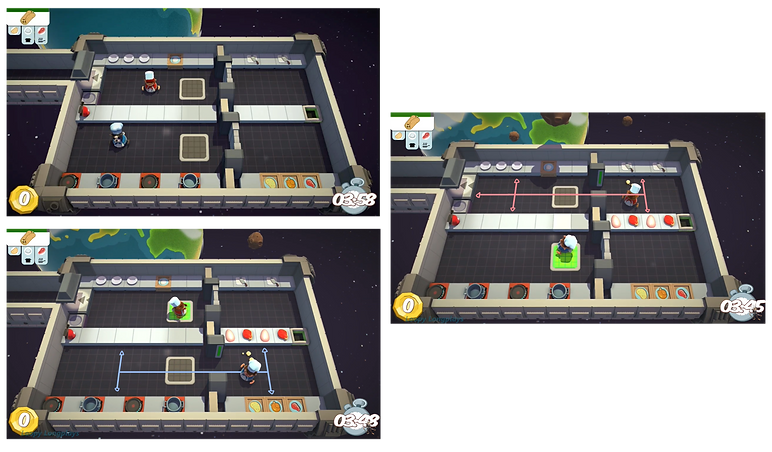
In stage 5-3, players are split up from the start, and can step on the pressure plates on the ground to open up the door for the players on the other side.
-
Step on pressure plates to open up door for other player
-
Other player will be trapped inside if the player steps off the pressure plate and the door closes
-
Requires players to have to constantly step on the pressure plate in order to let the other player in or out of the doorway
Without co-operation, players cannot move to the other side of the doors.
In Stage 5-6, pressure plates are also used but this time, in combination with conveyor belts.

Hazards
There are also many ways that levels are designed to introduce an element of danger that can cause players to die.
This is usually done through narrow platforms.
In stage 6-3, players have to traverse icy blocks that move in opposite directions and wait for them to line up before making a mad dash across.

-
Slippery ice, narrow ice blocks
-
Tables split the platforms, so players have to run across and back to get to the upper left corner
Changing up player roles
It is common for players to have a preferred role they wish to take on.
However, Overcooked is well-known for introducing many changes to the level environment, that effectively swaps player roles without giving them much choice.
This keeps the gameplay fresh as players aren't constantly doing the same things throughout the level.
For example, in stage 3-2, players are cooking aboard a ship that sways about. The tables will slide to the left after about 25 seconds and back to the right after the same interval.

-
Tables move, players must switch roles
-
Players needs to take turns chopping, boiling and serving
-
Players have to use middle tables to pass ingredients
This is also seen in stage 6-1, where the tables actually move in all 4 directions.

-
Table moves in all 4 directions
-
Players have to switch and adapt quickly to the change
-
Change in roles, not always just doing the same thing
From the above examples, there are a few recurring trends we can identify in Overcooked’s level designs:
-
Cooking and chopping tables are separated
-
Moving tables, pressure plates
-
Changing routes, moving platforms
-
Encourage co-op play
-
A good balance of player specific routes and generic routes, splits players up at times
-
Separated chopping stations and cooking stations
-
For straightforward routes, there are always obstacles that can kill the players like falling off platforms or fireballs
-
For generic routes (no player restrictions), the route should be long and windy, so players have to run a farther distance, which will balance the fact that all players can access the routes.
-
For player-specific routes, player workload must be balanced on both sides
Next, let's take a look at some specific levels.